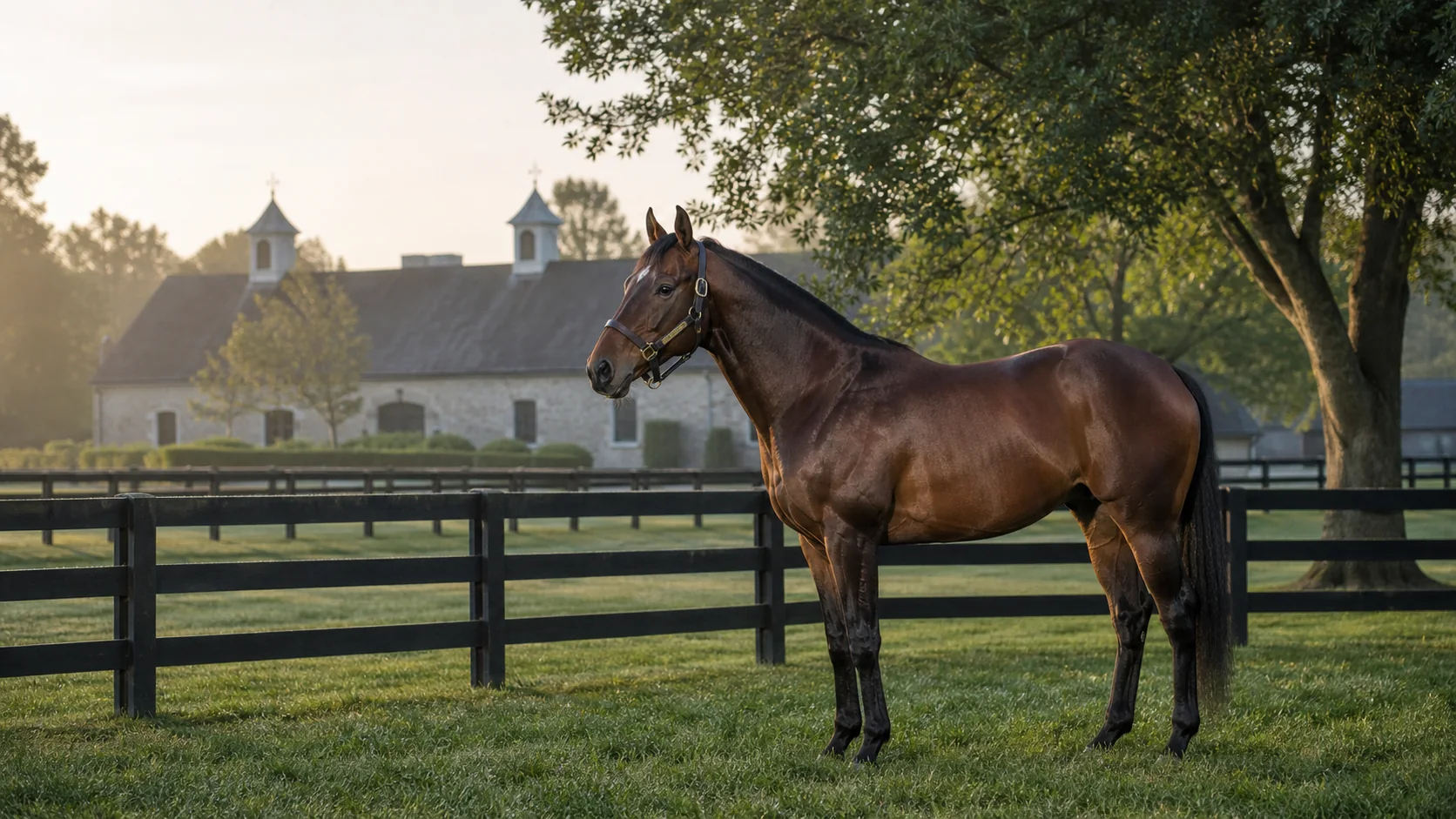
Orb's racing credentials
Orb was a bay colt foaled in 2010, bred and raced by the partnership of Stuart S. Janney III and Phipps Stable and trained by Claude R. "Shug" McGaughey III. After a modest juvenile season in 2012 that produced three off-the-board finishes before he broke his maiden at Aqueduct that November, he turned into one of the best three-year-olds in the country over the winter and spring of 2013. He reeled off four consecutive wins heading into the Kentucky Derby, then made it five straight in the Derby itself.
That winning run was built on genuine class rather than a soft schedule. He took a Gulfstream Park allowance, then the Grade 2 Fountain of Youth Stakes by a half length, then the Grade 1 Florida Derby by 2 3/4 lengths. On May 4, 2013, sent off as the 5-1 favorite, he closed from far back over a sloppy Churchill Downs strip to win the 139th Kentucky Derby by 2 1/2 lengths. He could not repeat that form in the rest of the Triple Crown and beyond, finishing fourth in the Preakness, third in the Belmont, and third in the Travers, and he retired with a record of 12 starts, five wins, and $2,612,516 in earnings.
Read plainly, that is the resume of a legitimate Grade 1 Classic winner who peaked in the spring of his three-year-old year rather than a horse who dominated every start. It is exactly the kind of profile that makes a colt an attractive stallion prospect, and exactly the kind that leaves room for honest debate about how good he really was.
| Date | Race | Result |
|---|---|---|
| Nov 24, 2012 | Maiden, Aqueduct | Won (first career win) |
| Jan 26, 2013 | Allowance, Gulfstream Park | Won |
| Feb 23, 2013 | Fountain of Youth Stakes (G2), Gulfstream Park | Won by 1/2 length |
| Mar 30, 2013 | Florida Derby (G1), Gulfstream Park | Won by 2 3/4 lengths |
| May 4, 2013 | Kentucky Derby (G1), Churchill Downs | Won by 2 1/2 lengths |
| May 18, 2013 | Preakness Stakes (G1), Pimlico | 4th |
| Jun 8, 2013 | Belmont Stakes (G1), Belmont Park | 3rd |
| Aug 24, 2013 | Travers Stakes (G1), Saratoga | 3rd |
| Sep 28, 2013 | Jockey Club Gold Cup (G1), Belmont Park | 8th |
See also: Kentucky Derby race guide · Fountain of Youth Stakes
The pedigree that made Orb a stallion prospect
A colt's page matters as much as his race record when breeders decide whether to support him at stud, because they are betting on what he can pass along. Orb was by Malibu Moon and out of the Unbridled mare Lady Liberty, and both sides carried the kind of American Classic influence that Kentucky breeders pay for.
Malibu Moon is a son of A.P. Indy, the 1992 Horse of the Year and one of the most important sires of his era, who is himself a son of Triple Crown winner Seattle Slew. That places Orb squarely in the Seattle Slew male line, a source of stamina, soundness, and Classic-distance ability. On the bottom side, his damsire Unbridled won the 1990 Kentucky Derby and went on to sire major winners, so Orb was, in effect, a Kentucky Derby winner descended on his dam's side from another Kentucky Derby winner.
That combination is why he was a commercially logical stallion prospect. He offered a proven top-of-the-line pedigree, a Grade 1 Classic win at ten furlongs, and the physical stamp of a horse bred to get a Derby distance. Pedigree is a probability, not a promise, but on paper Orb had close to the ideal page for a young Kentucky stallion.
See also: Why black type signals pedigree quality
Why Orb went to stud, and the 2013 to 2014 question
Orb was retired on November 5, 2013 and stood his first season at Claiborne Farm in 2014 for an advertised fee of $25,000. Claiborne is one of the most storied breeding operations in the world, and standing there gave Orb a genuine first-class opportunity: a strong initial book of mares, an established sales and marketing operation, and the credibility of the farm's name behind him.
That is the backdrop for the question people were actually asking in 2013 and 2014. A newly retired Classic winner with an elite pedigree, standing at a top farm, is precisely the profile that generates optimism, and the honest answer at the time was that nobody could know. Expectations were reasonably high but genuinely unproven. Breeders were paying a real fee for a horse whose ability to sire runners had not yet been tested by a single foal on the racetrack.
It is worth being clear about what "successful sire" even means, because the word carries at least two definitions that do not always move together. Commercial success is whether his foals sell well at auction, which is driven by fashion, sire-line popularity, and physical type. Racetrack success is whether his foals actually win, and win at a high level. A stallion can look good in one column and disappointing in the other, and Orb's story turns on exactly that gap.
First-year stallion versus freshman sire
These two terms get used loosely, but they mark different points in a stallion's timeline, and the distinction is central to understanding why the 2014 conversation about Orb was mostly speculation. A first-year or first-season stallion is a horse in his very first breeding season, covering mares for the first time. At that stage he has no runners at all, so everything said about him is inferred from his own race record and pedigree.
A freshman sire is a stallion whose first crop of foals has reached racing age, meaning his first two-year-olds are hitting the track. Because a foal conceived in the spring is born the following year and races at two the year after that, the freshman season arrives roughly three years after a horse first stands at stud. That is the first moment there is any real evidence of whether he can actually sire winners.
For Orb the timeline runs cleanly: he covered his first mares in 2014, his first crop was foaled in 2015 (reported at around 101 live foals), and those foals reached the races as two-year-olds in 2017, which was his freshman sire season. So the 2014 optimism was pure projection, and it took until 2017 for the market to begin scoring the bet on real results rather than pedigree alone. Grades and black type only start to attach to a sire once his runners begin earning them.
See also: What graded stakes actually mean
What Orb's runners actually accomplished
Orb did get his crops to the races, and he did sire winners, including one at the very top level. His best runner to date is Sippican Harbor, a filly who won the Grade 1 Spinaway Stakes at Saratoga on September 1, 2018, closing to win by two lengths at odds of 16-1. She became Orb's first Grade 1 winner, which is a meaningful line on any stallion's record.
He also stayed connected to the Classic picture through his son O Besos, a colt who finished third in the 2021 Louisiana Derby (G2) at 29-1 and went on to start in the 2021 Kentucky Derby, so a member of Orb's crop ran in the same race his sire had won eight years earlier. Beyond those names, Orb built up a broad base of winners and a handful of other stakes horses, among them Autumn Warrior, Eagle Orb, Orbolution, and Trixie Power. At the time of his 2021 sale he was credited with 157 winners and eight black-type (stakes) winners, one of them a Grade 1 winner.
That is a real body of work, and it is more than many stallions ever produce. But it is also the shape of a solid regional-quality sire rather than a fashionable Kentucky success: a lot of winners, a modest number of stakes horses, and a single top-level star rather than a steady flow of graded performers. One headline horse like Sippican Harbor proves he could sire a Grade 1-level runner; it does not, by itself, make him a commercially successful stallion.
See also: Travers Stakes · Belmont Stakes
How to judge a stallion beyond one headline horse
A single Grade 1 winner is easy to point to and easy to overweight. Evaluating a sire fairly means looking at the whole population of his foals and at rates rather than individual names. A few questions do most of the work.
By these measures the pattern for Orb is consistent. His yearlings sold for as much as $1,000,000 and his two-year-olds for as much as $1,250,000, so individual foals could be commercially attractive. But strong outlier sale prices are not the same as a strong average, and the racetrack results across his crops did not build the kind of graded-winner depth that keeps a horse in demand at a premium Kentucky fee.
- Rates, not totals: what share of his starters win, and what share of his foals earn black type, rather than the raw count of winners.
- Depth versus a single star: does he produce stakes horses across multiple crops, or does his record lean on one or two standouts?
- Quality of the stakes horses: graded and Grade 1 winners carry far more weight than minor stakes placings.
- Commercial versus racetrack results: strong sale prices can mask weak race results, and strong race results can be ignored by a market chasing fashion.
- Opportunity: the size and quality of his books of mares, since a stallion given better mares should be expected to produce better runners.
- Aptitude transfer: whether his foals reproduce his distance and surface profile, which tells breeders what he is actually good for.
See also: Black type and listed races
A verdict in hindsight
Weighing the evidence, the fairest reading is that Orb became an honest, useful stallion who was given a genuine top-tier chance and did not develop into a commercial success in Kentucky. He sired plenty of winners and one Grade 1 winner in Sippican Harbor, but his overall results fell short of the standard required to hold a place at a farm like Claiborne at a premium fee.
The market signaled that plainly. He opened at a $25,000 fee in 2014, but demand thinned over time: he covered just seven mares in 2020, a steep drop for a Classic winner at a top farm. In April 2021 he was sold to a coalition of about two dozen Uruguayan breeders and exported to stand at Haras Cuatro Piedras in Uruguay. A move like that is the industry's way of saying a stallion no longer fits the commercial Kentucky market, even when he has done nothing wrong.
So the answer to the 2013 to 2014 question is a qualified no. Orb had the race record, the pedigree, and the opportunity to succeed at stud, and he still did not become a commercially successful Kentucky sire. That outcome is not a failure of the horse so much as a reminder of how breeding actually works: racing class transmits unreliably, most Classic winners do not become important sires, and the only honest way to answer "will this horse make a good sire" is to wait for the foals to run. Orb's runners ran, produced a Grade 1-winning filly and a Derby starter, and ultimately told a clear story.
See also: Major race guides
Common questions
Was Orb a successful sire?
By racetrack measures he was a useful but not standout stallion: he sired many winners and one Grade 1 winner, Sippican Harbor, who took the 2018 Spinaway Stakes. By commercial Kentucky measures he fell short. His book of mares thinned to just seven covers in 2020 after opening at a $25,000 fee in 2014, and he was sold to breeders in Uruguay in April 2021, which is how the market signals that a stallion no longer fits a premium Kentucky roster.
Where did Orb stand at stud?
Orb was retired in November 2013 and entered stud at Claiborne Farm in Paris, Kentucky, for the 2014 breeding season at an advertised fee of $25,000. He stood there through the 2020 season before being sold in 2021 to a coalition of Uruguayan breeders and exported to stand at Haras Cuatro Piedras in Uruguay.
What is the difference between a first-year stallion and a freshman sire?
A first-year (or first-season) stallion is covering mares for the first time and has no runners yet, so he is judged only on his own race record and pedigree. A freshman sire is one whose first crop of foals has reached racing age and is running as two-year-olds, which is the first year there is real evidence of whether he can sire winners. For Orb, 2014 was his first season and 2017 was his freshman sire year.
Who was Orb's best runner?
His best runner to date is the filly Sippican Harbor, who won the Grade 1 Spinaway Stakes at Saratoga on September 1, 2018 at 16-1 and became Orb's first Grade 1 winner. His colt O Besos was third in the 2021 Louisiana Derby and started in the 2021 Kentucky Derby, the race Orb himself had won in 2013.
Further reading
Sources and historical records
- Claiborne Farm: Kentucky Derby-G1 winner Orb retired to Claiborne
- Claiborne Farm: Stallion Spotlight, Orb
- BloodHorse: Coalition in Uruguay Buys Kentucky Derby Winner Orb
- BloodHorse: Sippican Harbor Upsets Spinaway
- America's Best Racing (The Jockey Club): Orb
- Daily Racing Form: Uruguay breeders partner to purchase Orb